
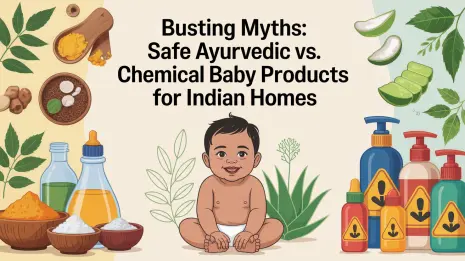
If you’ve ever stood in a supermarket aisle comparing Ayurvedic vs Chemical Baby Products, wondering whether that green label actually means safer, you’re not alone. Most Indian parents go through the same confusion. I still remember the day I held two baby lotions in my hand, both claiming to be “gentle,” and neither giving me real clarity. Which one was genuinely safe? Which one was simply marketing? And why does everything suddenly look organic even when it’s not?
Somewhere between family advice and glossy advertisements, the truth gets buried. That is exactly why this blog exists. To take those myths apart, one by one, in a way that feels honest, practical, and grounded in real Indian households.
Before we get into the deep comparison, let’s look at why the conversation has become so important. Baby skin is thinner, more absorbent, and reacts faster to irritants than adult skin. When a baby’s skin absorbs chemicals or even harsh plant extracts, the impact is stronger. So understanding what goes onto your baby’s skin isn’t optional anymore. It is essential.
Understanding Ayurvedic vs Chemical Baby Products in India
Most people assume Ayurvedic products are automatically better, and chemical products are automatically harmful. But things are not that simple. Ayurveda is a science rooted in natural ingredients, but not all natural ingredients are safe for a newborn’s skin. Similarly, not all chemical formulations are harmful. Some are carefully designed, tested, and proven safe.
When I first started researching this topic, I was surprised to learn that certain essential oils considered beneficial for adults can actually irritate a baby’s skin. On the other hand, purified, clinically tested chemical ingredients like glycerin or ceramides can protect the skin barrier better than raw plant extracts. It made me rethink everything I believed.
To understand the truth, we need to look at both sides fairly.
Safety of Ayurvedic Baby Products in Modern Indian Homes
Ayurvedic products often use herbs, plant extracts, cold-pressed oils, and natural essences. These ingredients are typically gentle. But the challenge lies in purity, concentration, and formulation. Just because something is natural doesn’t mean it is suitable for a baby with delicate skin.
For example, neem and tulsi are excellent for adults, yet too strong for newborns. The same goes for camphor, eucalyptus oil, and certain herbal pastes. Ayurveda requires balance. When brands don’t respect that balance, reactions happen.
The good news is that high-quality Ayurvedic brands follow classical formulations and modern safety testing. These are safe. But low-quality brands just use the “Ayurvedic” tag as a marketing tool.
So how do you tell the difference? Look for these signs
- Clinical testing mentioned on the label
- Shorter ingredient list
- No artificial fragrance
- No essential oils in high percentages
- Certifications from AYUSH or dermatologists
Even the most authentic Ayurvedic product must suit the baby’s skin type. Parents need to observe how the baby reacts.
Harmful Chemicals in Baby Shampoo India: What Should Parents Avoid
Indian markets are filled with baby shampoos that proudly display claims like “no tears formula,” yet many still contain surfactants and preservatives that may irritate sensitive skin. Parents often assume that if it’s sold for babies, it must be safe. But unless you read the ingredient list carefully, that assumption can mislead you.
Common harmful chemicals found in baby shampoo in India include
- SLS and SLES
- Artificial fragrances
- Parabens
- Phthalates
- Formaldehyde releasers
Not all chemicals are harmful, and not all natural ingredients are safe. But the ones above should ideally be avoided. They can dry out the scalp, cause mild irritation, or disrupt the natural pH balance.
A surprising fact I discovered while researching this blog was that many popular Indian shampoos marketed as “mild” actually contain SLES. The brand name doesn’t guarantee safety. The ingredient list does.
Natural Baby Soap vs Commercial Soap: Which Is Truly Better
If there is one thing Indian parents debate endlessly, it’s whether to use Natural Baby Soap vs Commercial Soap for daily bathing. My grandmother swears by handmade soap, while a pediatrician once recommended a pH-balanced commercial cleanser. So who is right?
Natural soaps are often rich in oils like coconut, sesame, or almond. They nourish the skin, but can sometimes leave a residue or feel heavy, especially in humid climates. On the flip side, commercial soaps are more consistent and stable, yet some contain artificial fragrances and foaming agents.
The real winner isn’t the category. It is the formulation.
A truly safe soap should ideally be
- pH balanced
- Free from harsh surfactants
- Free from artificial colors
- Moisturizing without being greasy
Sometimes a commercial cleanser with mild ingredients performs better than a natural soap overloaded with essential oils.
TABLE: Quick Comparison of Ayurvedic vs Chemical Baby Products in India
| Feature | Ayurvedic Baby Products | Chemical Baby Products |
| Base Ingredients | Natural herbs, oils, plant extracts | Formulated chemicals, synthetic compounds |
| Safety Consistency | Can vary depending on purity | More consistent due to controlled formulation |
| Allergy Risk | Higher if strong herbs are used | Moderate if mild chemicals used |
| Skin Suitability | Great for mild, natural care | Great for targeted solutions like dryness or eczema |
| Cost | Often higher | Varies widely |
| Fragrance | Natural aroma, sometimes strong | Artificial fragrance (can cause irritation) |
Common Misconceptions about Ayurvedic Baby Care
People love to believe that Ayurveda means completely risk-free. But that belief can mislead parents. Ayurveda is powerful, not weak. And power requires caution. Here are a few misconceptions I come across often
- Natural ingredients can’t irritate baby skin. They can.
- Every plant extract is safe for newborns. It isn’t.
- Ayurvedic products don’t need testing. They absolutely do.
- Herbs work for all babies equally. They don’t.
When I became a parent, my assumption was that natural products could never go wrong. But after my baby got a rash from herbal oil, I learned that even nature must be handled wisely. The goal of Ayurvedic baby care is balance, not blind trust.
BLOG QUOTE
“A baby’s skin doesn’t need labels. It needs honesty, purity, and products tested with intention, not marketing.”
Why Indian Parents Are Switching to Best Baby Products in India with Safer Formulations
One trend has become very clear: modern parents in India are more informed than ever. They compare ingredients, research safety reports, and read reviews before buying anything. This shift is happening because the older belief that “whatever is sold for babies is safe” no longer feels convincing.
The best baby products in India**** today follow a hybrid approach. They combine gentle natural ingredients with proven safe scientific formulations. This approach respects both Ayurveda and dermatology.
Whether you choose Ayurvedic or chemical products, the real goal is simple: find what keeps your baby’s skin healthy without unnecessary additives.
The Rise of Natural Baby Lotion India and Hybrid Formulations
Natural baby lotions have become extremely popular, especially in urban Indian households. Parents want moisturizers that aren’t sticky, don’t have strong fragrances, and absorb quickly. Natural Baby Lotion India brands have been trying to meet that need by blending plant-based oils with mild safe synthetics.
This combination provides the nourishment of natural oils and the stability of modern formulations. The result is gentle hydration without heaviness or reactions.
How Ayurvedic vs Chemical Baby Products Work on Baby Skin Barrier
Once I started studying the science behind baby skin, things became clearer. A baby’s skin barrier is not like ours. It is thinner, loses moisture quickly, and responds strongly to even mild ingredients. That is why both Ayurvedic and chemical products can impact the skin differently.
Ayurvedic products usually nourish the skin barrier using oils and herbal extracts. These ingredients strengthen the outer layer naturally. But they also need correct proportions. Too much oil can clog pores. Too many herbs can be irritating.
Chemical baby products, especially dermatologist-approved ones, work by stabilizing the skin barrier. They use scientifically validated ingredients like glycerin, ceramides, and mild surfactants that restore moisture without overwhelming the skin.
The real deciding factor is not whether the product is Ayurvedic or chemical. It is how well the product respects your baby’s skin structure. And honestly, many parents discover this only after a trial-and-error phase.
When Ayurvedic Baby Products Are the Better Choice
Ayurvedic formulations have undeniable strengths. They work especially well when you need
- Gentle nourishment
- Oil-based moisturization
- Mild cleansing
- Products free from synthetic fragrances
For babies who have naturally dry skin, Ayurveda can be a blessing. Oils like coconut, sesame, almond, or cow ghee have been used for generations in Indian homes. They hydrate deeply and help protect the skin against environmental dryness.
However, the suitability improves drastically when the product uses pure ingredients and accurate concentrations. Ayurveda was designed to be customized. What works for one baby may not work for another.
I remember speaking to a pediatric dermatologist once who told me something interesting: “Ayurveda is amazing when used with precision. But when brands overstuff products with too many herbs or strong botanical extracts, reactions happen.” That advice has stayed with me.
When Chemical Baby Products Are the Better Choice
People often hesitate to use chemical baby products because of the word “chemical.” However, water is a chemical too. The key is whether the chemicals used are safe, hypoallergenic, and tested.
You might choose chemical-based products when
- The baby has eczema
- The baby has allergies
- The baby needs pH-balanced cleansing
- The skin requires restoring lipids
- A pediatrician recommends something specific
Ingredients like ceramides, panthenol, and mild surfactants are backed by scientific studies. These help rebuild the skin barrier faster than many natural ingredients. This is particularly useful during skin flare-ups or dryness caused by seasonal changes.
For example, in winter, even full Ayurvedic moisturizers sometimes fall short. In such cases, a ceramide lotion or fragrance-free synthetic moisturizer can give quicker results.
So instead of asking whether Ayurveda is better than chemicals, the real question should be What does your baby’s skin need today?****
Do Ayurvedic vs Chemical Baby Products Perform Differently in Indian Climate
The Indian climate plays a huge role in baby skincare. Parents in humid regions face completely different challenges from those in dry, cold areas. And the performance of both Ayurvedic and chemical baby products changes depending on the climate.
In humid states like Kerala or coastal Karnataka, thick Ayurvedic oils may feel heavy. Babies sweat more, leading to occasional clogged pores or small bumps. In such cases, a lightweight chemical lotion or hybrid product works better.
In dry northern regions, Ayurvedic oils and butters perform beautifully. They hydrate deep into the skin and retain moisture longer.
Climate matters more than most parents realize. When I first traveled from Bangalore to Rajasthan with my child, his usual moisturizer suddenly failed. That’s when I learned that even the most trusted product can react differently in another climate.
Ayurvedic vs Chemical Baby Products for Hair Care
Hair care often gets ignored in this conversation, yet baby hair and scalp are extremely delicate.
Ayurvedic hair oils like bhringraj, coconut, and amla work beautifully when diluted properly. They strengthen the scalp gently and encourage soft hair growth.
Chemical baby shampoos, when mild and sulfate-free, cleanse better. Babies with cradle cap or flaky scalp benefit from pH-balanced chemical formulations more than herbal ones. Ayurveda does not always solve scalp flaking because it was not designed for modern dermatological concerns.
- A balanced approach often works best
- Use Ayurvedic oil before bath
- Use mild, chemical-free or hybrid shampoo for cleansing
This routine supports both tradition and modern safety.
High-Volume Ingredients Indian Parents Should Look For
To choose wisely, parents must know which ingredients to trust. Here are a few high-volume safe ingredients commonly used in top Indian baby care brands.
For Ayurvedic products
- Cow ghee
- Cold-pressed coconut oil
- Kumkumadi oil
- Aloe vera
- Calendula
For chemical or hybrid products
- Glycerin
- Panthenol
- Ceramides
- Mild amphoteric surfactants
- Non-fragrant moisturizers
These ingredients appear in some of the Best Baby Products in India, and their safety has been evaluated over decades.
Red Flags Indian Parents Should Avoid Immediately
During my research, I came across some alarming patterns in Indian baby products. Avoid these red-flag ingredients no matter which category the product belongs to.
Very strong herbal extracts like
- Eucalyptus
- Camphor
- neem oil in high concentration
Harsh chemical ingredients like
- SLES
- Parabens
- Phthalates
- Chemical dyes
- Formaldehyde releasers
Baby products should never smell too strong or feel too greasy. Any overpowering fragrance is a sign of artificial scent, which is a known irritant.
How to Read Baby Product Labels (The Indian Parent Cheat Sheet)
This is something I wish someone had taught me earlier. Most product labels hide behind long chemical names, confusing even educated parents. But once you know the basics, you can decode labels within seconds.
Look at the first 5 ingredients. These make up most of the product.
- Identify if fragrances are natural or added.
- Check if the product mentions hypoallergenic testing.
- Shorter ingredient lists are usually safer.
- Avoid products with too many herbs or long lists of synthetics.
Reading labels is easier once you know what to ignore.
Ayurvedic vs Chemical Baby Products: Which Is Truly Safer
After analyzing everything from ingredients to climate suitability, cultural practices, dermatological advice, and real parent experiences, one conclusion stands out clearly.
Safety is not determined by whether a product is Ayurvedic or chemical. Safety is determined by
- Purity
- Testing
- Formulation
- Concentration
- How it suits your baby’s skin
Both categories have safe products. Both categories have unsafe products. Both categories need parents to make informed decisions.
One of the pediatricians I consulted made an interesting point: “Choose what your baby’s skin responds well to, not what advertisements tell you.”
Hybrid Baby Products: The New Middle Path for Indian Parents
A new generation of baby products has emerged in India. These hybrid formulations use the best of both worlds. They take gentle Ayurvedic ingredients like aloe or coconut oil and blend them with safe scientific ingredients for stability and performance.
These products solve
- Moisture loss
- Mild irritation
- Everyday cleansing
- Skin barrier strengthening
Without going overboard on either the herbal or synthetic side.
Hybrid products have quickly earned the trust of urban parents because they feel balanced, practical, and dependable.
The Future of Baby Care in India: What Trends Are Shaping 2026 and Beyond
As parents become more informed, brands are forced to become more transparent. Over the next few years, experts predict a big shift in baby skincare:
- Higher demand for dermat-tested Ayurvedic products
- More fragrance-free baby products
- pH-balanced cleansers designed for Indian climate
- Safer preservatives to extend shelf life without irritation
- Ingredient transparency becoming compulsory
Ayurvedic vs Chemical Baby Products**** will continue to be a trending topic because Indian parents want both tradition and science. That balance is the future.
Final Comparison Table: Which Should Indian Parents Choose
| Criteria | Ayurvedic Baby Products | Chemical Baby Products | Hybrid Baby Products |
| Best For | Nourishment, dry skin | Sensitive skin, eczema | Daily use, balanced skin |
| Risks | Overuse of herbs | Harsh synthetics | Very low |
| Climate Suitability | Dry regions | Humid regions | All climates |
| Safety Testing | Varies | High in top brands | High |
| Cost | Medium to high | Medium | Medium |
Conclusion: What Should You Actually Choose for Your Baby
At the end of the day, every baby is unique. Their skin reacts differently to products, climates, and ingredients. Instead of choosing between Ayurvedic vs Chemical Baby Products**** based on assumptions, choose based on observation.
Watch how your baby’s skin responds.
- Patch test everything.
- Choose gentle, tested formulas.
- Avoid extremes.
- Respect both tradition and science.
If you stay mindful and curious, your baby’s skin will guide you naturally toward what works best.
FAQs
Q1. Are Ayurvedic baby products always safer than chemical ones?
Not always. Safety depends on purity, testing, concentration, and how well the product suits your baby’s skin. Both categories can be safe when formulated correctly.
Q2. Which harmful chemicals should Indian parents avoid in baby shampoo?
Avoid SLS, SLES, parabens, phthalates, formaldehyde releasers, and artificial dyes. These can irritate sensitive baby skin and scalp.
Q3. Is Natural Baby Soap better than Commercial Baby Soap?
Not necessarily. Natural soaps can be nourishing but heavy in humid climates. Commercial cleansers can be gentle if they are pH balanced and free from harsh ingredients. The right choice depends on your baby’s skin type.
Q4. Can Ayurvedic herbs irritate a baby’s skin?
Yes. Strong herbs like neem, eucalyptus, camphor, and tulsi can irritate sensitive newborn skin when used in high concentrations.
Q5. What is the safest option: Ayurvedic, chemical, or hybrid baby products?
Hybrid products often offer the best balance. They provide natural nourishment with scientific safety and stability.